The short version
Fund accounting software has one job that cannot be faked: at the end of a period, the general ledger, the NAV, and every investor's capital account have to agree with each other. Everything else on a feature list is in service of that, and most of the pain in this industry comes from systems where those three things are maintained separately and reconciled afterwards.
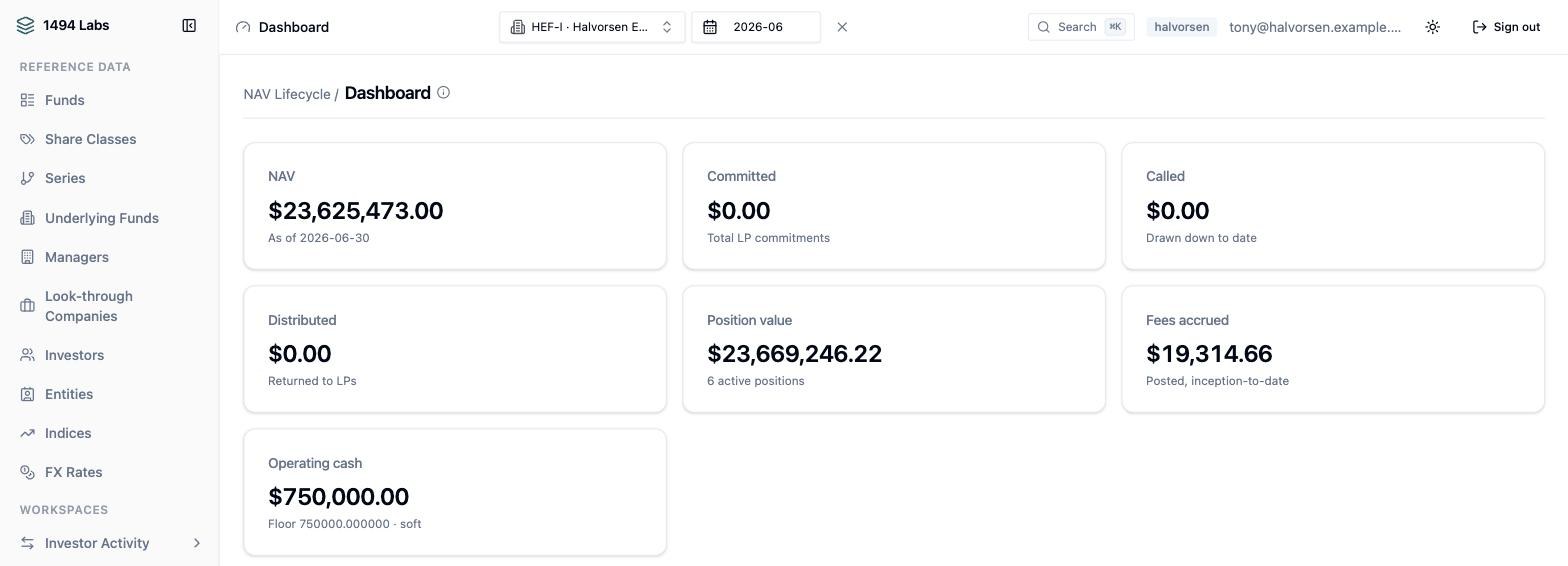
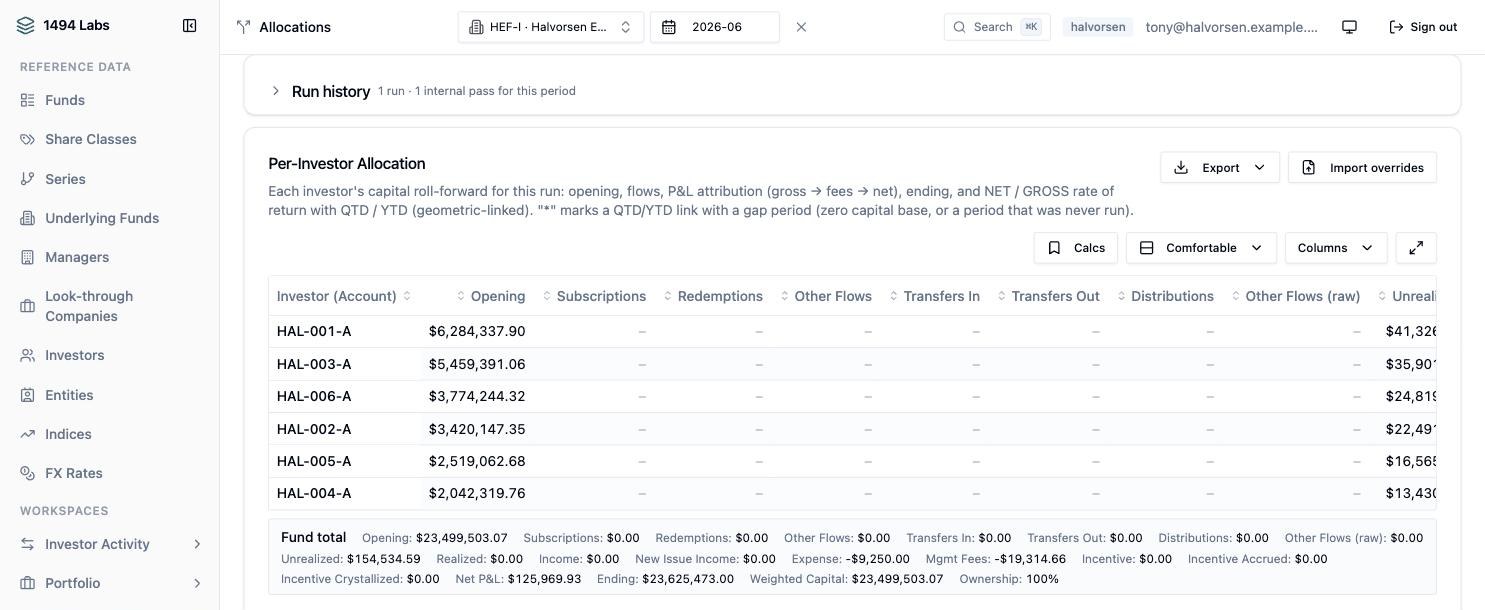
1494 Labs is built the other way round. One ledger carries the accounting book and the investment book. Capital accounts are derived from postings rather than kept beside them. Ownership is derived from capital rather than asserted alongside it. And a sweep of fifty-seven arithmetic invariants runs against live funds every day, so a book that has drifted says so before an auditor finds it.
- ✓One ledger for the accounting book and the investment book
- ✓Capital accounts derived from the ledger, per investor, per period
- ✓Fifty-seven invariants checked daily against live funds
- ✓Financial statements that are reads of the book, not exports from it
- ✓Every screen runs on the same public API you get
One ledger, two books
The accounting book of record and the investment book of record answer different questions on different clocks, which is why they usually end up in different systems with a reconciliation between them. That reconciliation is somebody's job every morning, and it is the source of a large share of the operational risk in fund administration.
Recording each economic event once, and treating trade date and settlement date as lenses over the same journal entries, removes the reconciliation rather than automating it. That is a stronger claim than "our reconciliation is very good", and it is worth being precise about which one a vendor is making. We wrote up the distinction, and how to test it, in ABOR and IBOR, and why most systems keep them apart.
Every vehicle, not a product tier per vehicle
Pooled funds, funds-of-one, separately managed accounts, trusts, family partnerships, holding companies and asset SPVs. Open-end and closed-end. Unitized and capital-based. Master-feeder structures where the feeder picks up master profit and loss through a real internal position rather than a journal entry somebody types each month.
Funding model is a property of the fund. A closed-end fund gets commitments, calls, drawdowns, recallable distributions and a waterfall; an open-end fund gets subscriptions, redemptions, series and high-water marks. Both post to the same ledger, and a fund that changes shape does not change systems.
The books, and everything that reads them
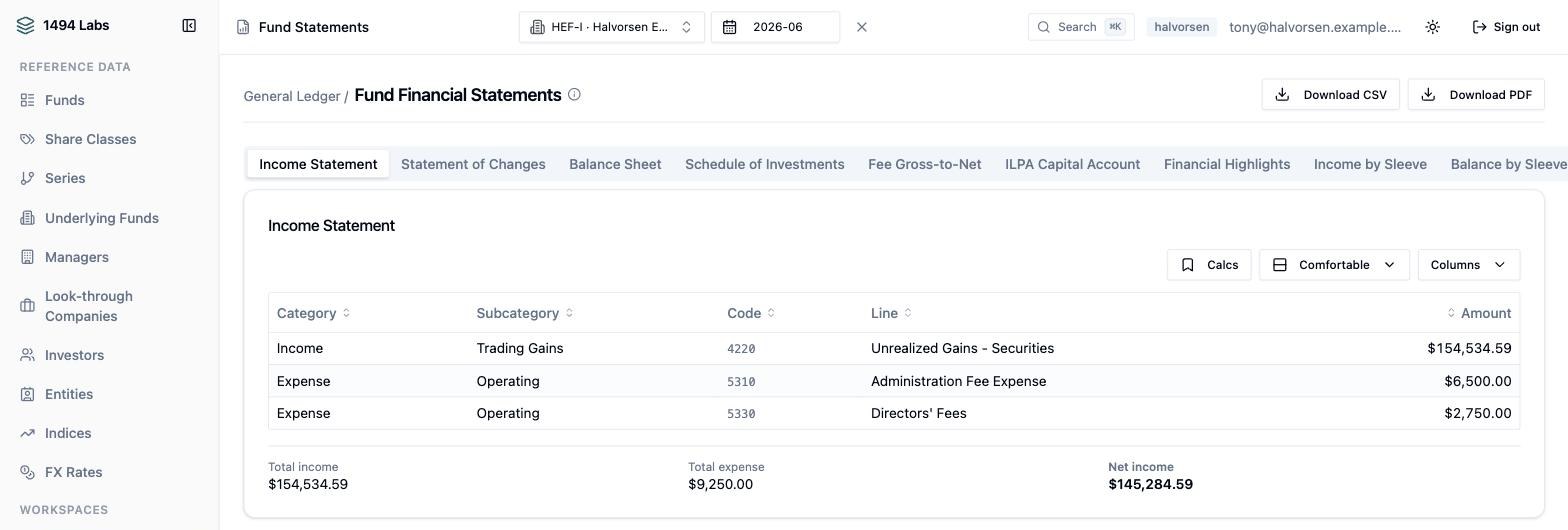
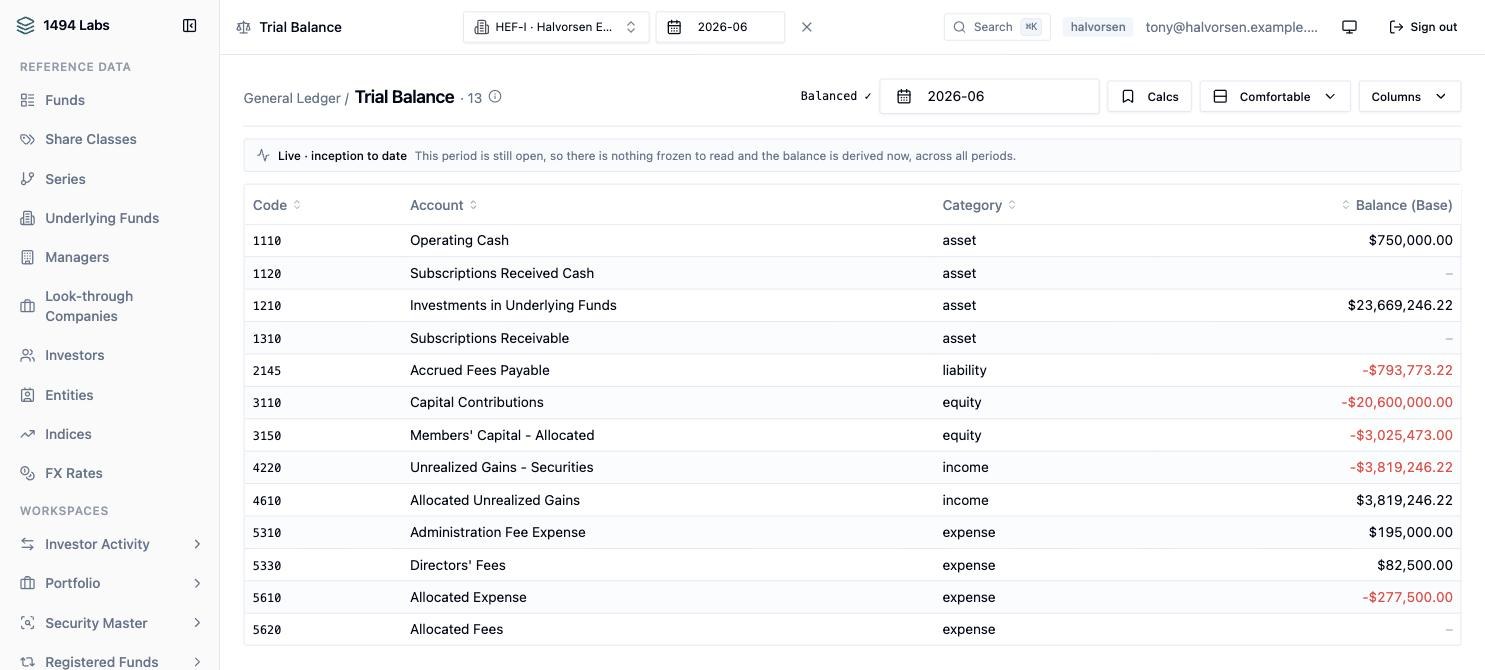
An income statement, a balance sheet, a statement of changes in partners' capital and a schedule of investments are four questions put to one ledger. Ending capital on one ties to NAV on another because it is the same book read twice, not two reports assembled from two extracts.
Proof, not assertion
An accounting oracle runs fifty-seven invariants against every live fund, every day. Not a test suite over fixtures: arithmetic truths checked against real money. Capital accounts reconcile to the ledger per fund and per period. Allocations sum to the pool, so no rounding leaks into somebody's balance. No lot outlives the position it belongs to. Every high-water mark survives redemption, transfer and restatement.
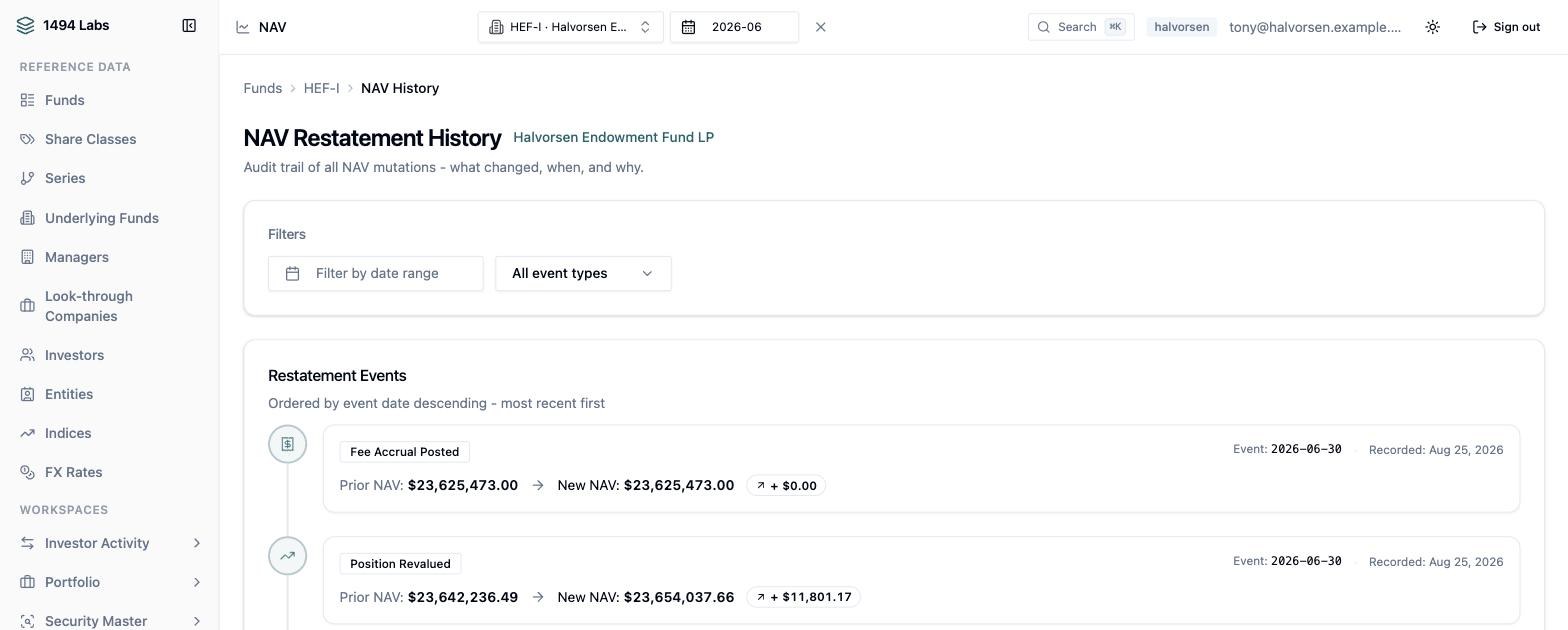
When a number does change, the change keeps its own record: prior value, new value, delta and cause, per event. A correction is a fact about the book, not an embarrassment to be smoothed over.
Built for the vehicle you actually run
- Private equity and closed-end funds · commitments, calls, waterfalls, carry
- Hedge funds and open-end vehicles · series, equalization, high-water marks
- Family offices · consolidated net worth across the whole structure
- Fund administrators · many clients, one platform
Currently in private development
Built for the people who have to sign the books rather than only read them. If this is your problem, we would like to hear how you have it.